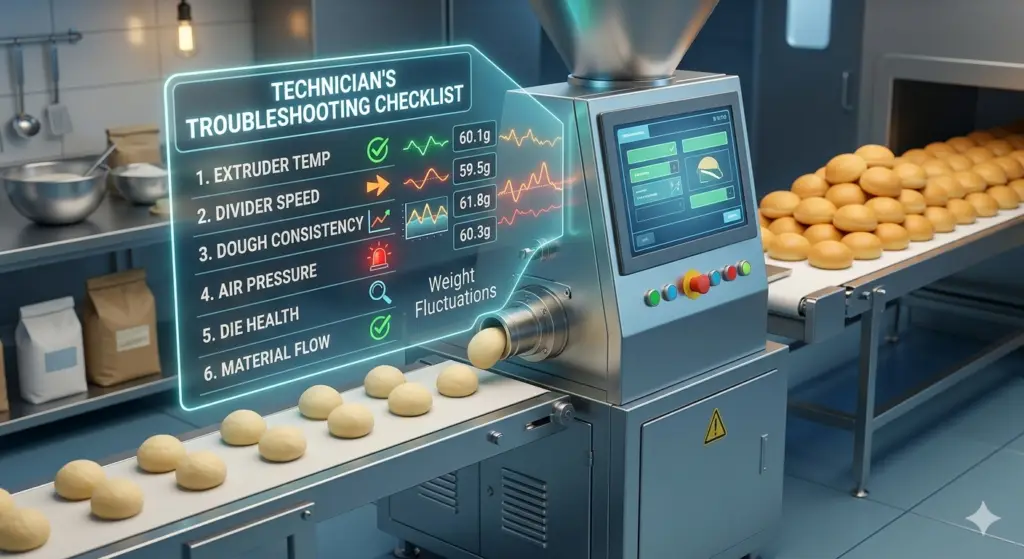
To fix bun divider weight fluctuations, verify that dough temperature remains stable within ±1°C. Additionally, inspect the suction piston for vacuum leaks and ensure the oiling system provides a consistent film. Buildup in the pressure box or worn piston seals represents the most common mechanical causes of weight drift.
🔹 Key Takeaways
- Control Temperature: Dough density shifts as fermentation progresses, which alters the weight-to-volume ratio.
- Inspect Seals: Worn rings allow air to bypass the dough and create “light” pockets.
- Clean Sensors: Ultrasonic sensors must remain free of flour dust to ensure accurate hopper head-pressure.
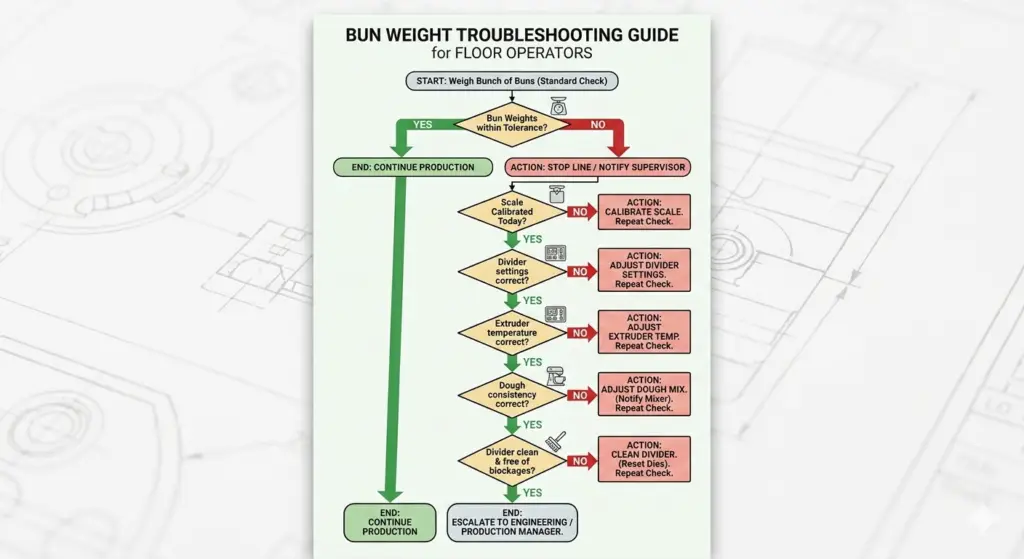
In industrial baking, weight inconsistency often appears as a “dough problem.” However, it usually stems from a mechanical failure in volumetric displacement. Even a 2g variation per bun can cost a high-volume plant thousands of dollars in weekly giveaway. Consequently, you must isolate variables immediately. Determine if the dough density is changing or if the machine is failing to fill the pocket.
Systematic Steps to Stabilize Bun Weights
1. Monitor Dough Thermal Stability
Start by checking the dough temperature with a calibrated probe. Specifically, verify that the dough stays between 18°C and 24°C. If the temperature rises by 2°C or more, the dough expands and becomes less dense. Consequently, you must increase the volumetric stroke to maintain the target weight.
2. Verify Hopper Head-Pressure
Next, observe the dough level in the hopper. Because low levels reduce the “gravity feed” force, the machine may struggle to fill pockets completely. Therefore, you should maintain a consistent stack height to ensure uniform pressure in the manifold.
3. Inspect the Oiling and Suction System
A dry pocket creates significant friction. If weight fluctuations occur in only one lane, the oil delivery nozzle for that specific piston is likely restricted. Furthermore, you should manually cycle the piston to listen for “hissing.” This sound indicates a failing vacuum seal, which prevents a full draw of dough into the chamber.
Root Causes of Process Deviations
🔹 Common Problems
- Equipment Wear: Worn piston bushings cause an uneven mechanical stroke.
- Process Errors: Using “scrap” dough at uneven ratios changes the specific gravity of the batch.
- Operator Oversight: Failing to purge the machine after a 30-minute downtime leads to crusted dough in the manifold.
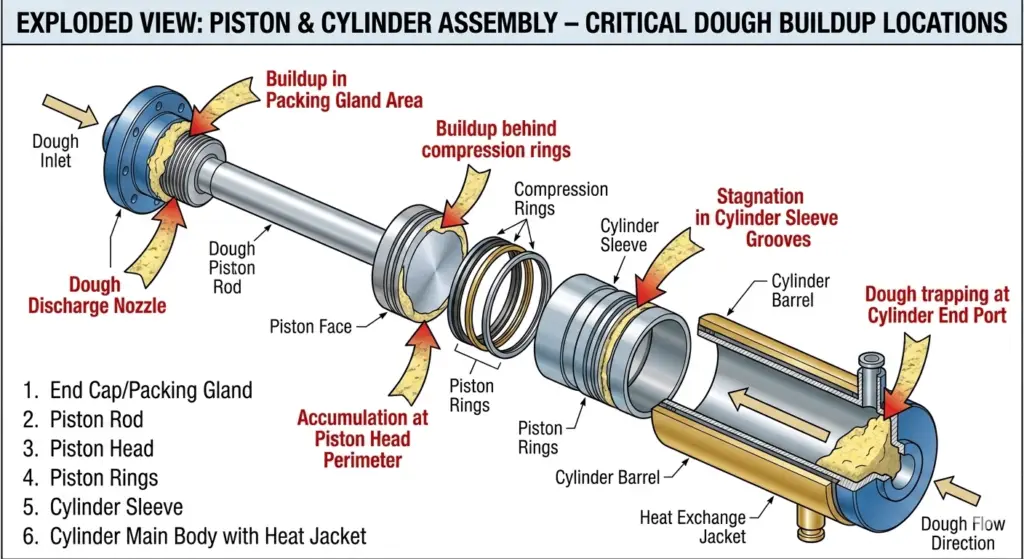
🔹 What the Manual Doesn’t Tell You: The “Hidden Failure” is often Back-Pressure Creep. Over an 8-hour shift, fine dough particles migrate behind the piston head. This buildup acts as a mechanical stop and effectively shortens the piston stroke. Although the machine “thinks” it is at full displacement, the physical volume is actually reduced. Action: Perform a “mid-shift purge” of the piston housing to clear this debris.
Diagnostic Reference Table
| Symptom | Probable Cause | Technical Fix |
| Random Light Pieces | Air pockets or large bubbles | Adjust degassing roller gap |
| Gradual Weight Loss | Dough Temp Rise (>2°C) | Increase volumetric stroke |
| Violent Weight Swings | Worn Piston Linkage | Replace pins and bushings |
| Single Lane Failure | Clogged Oil Port | Flush oil lines with compressed air |
| Heavy Initial Pieces | Hopper overfill | Recalibrate level sensors |
Critical Mistakes to Avoid
🔹 Common Mistakes
- Chasing the Handwheel: Technicians often adjust the volume without checking the dough temperature first.
- Over-Oiling: Excess oil can get trapped in the pocket. This displaces the dough and causes “holes” in the finished bun.
- Ignoring the Knife: A dull divider knife tears the dough rather than shearing it, which causes inconsistent fill pressure.