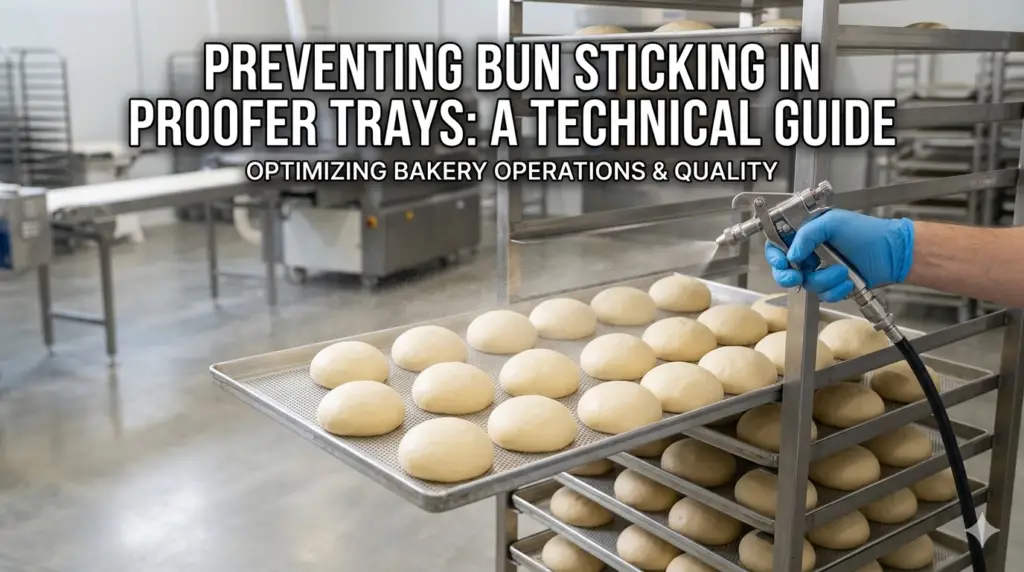
To prevent bun sticking in proofer trays, maintain proofer humidity below 85% and ensure tray temperatures match the dough temperature (±2°C). Specifically, check for condensation on tray surfaces. Use a high-smoke-point release agent or ensure dry-dusting flour remains below 14% moisture to prevent paste formation.
🔹 Key Takeaways
- Thermal Matching: Cold trays in warm proofers cause condensation, which creates a permanent bond between dough and mesh.
- Humidity Control: Excessive moisture turns dusting flour into an adhesive paste.
- Surface Integrity: Degraded silicone coatings or “carbonized” oil buildup increase surface friction.
Product sticking at the proofer discharge is a leading cause of production downtime and manual intervention. When buns adhere to trays, the transfer to the oven becomes uneven. Consequently, this leads to deformed products and damaged crumb structures. To solve this, you must analyze the interaction between the dough skin, the tray surface, and the atmospheric dew point within the proofer cabinet.
Systematic Fixes for Tray Adhesion
1. Eliminate Surface Condensation
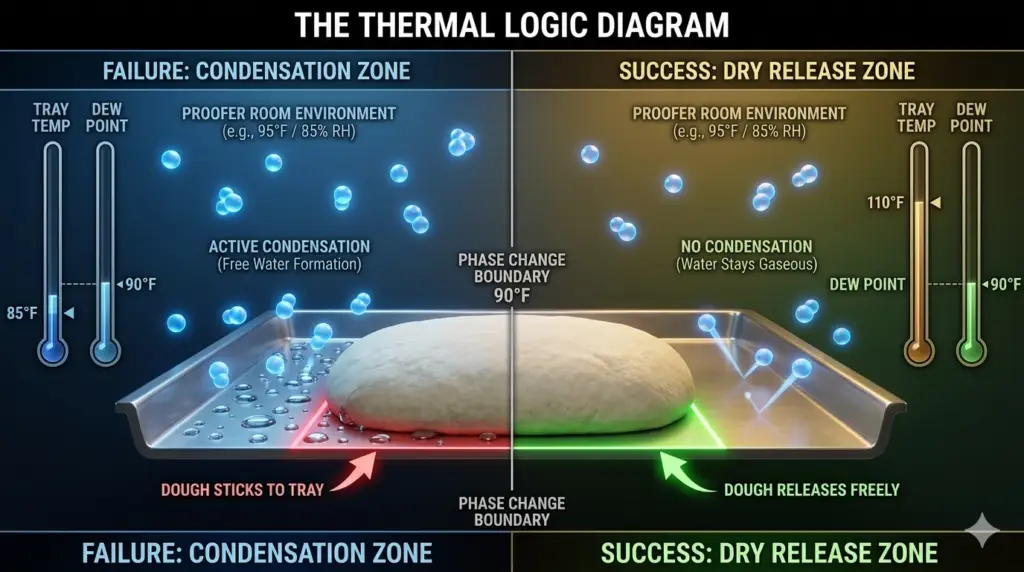
Condensation acts as a primary catalyst for sticking. Specifically, if your trays are stored in a cool staging area before entering the proofer, they will hit the dew point immediately. Because the moisture settles on the tray mesh, it hydrates the dough surface into a glue. Therefore, you should pre-heat trays to at least 32°C before they reach the loading station.
2. Optimize Relative Humidity (RH)
High humidity levels are necessary for yeast activity. However, exceeding 85% RH often leads to “wet skins.” When the dough surface becomes overly saturated, it sinks into the crevices of the tray mesh. You should monitor your wet-bulb/dry-bulb sensors closely. If the difference between the two is less than 2°C, your humidity is likely too high for the current tray temperature.
3. Verify Release Agent Performance
Release agents eventually degrade due to heat and oxidation. Specifically, if you use vegetable-based oils, they can polymerize and become tacky. Consequently, you must verify that your automatic sprayers are providing a uniform, atomized mist rather than large droplets. Additionally, consider switching to a permanent silicone coating if your maintenance budget allows for a long-term ROI.
Thermal Diagram: A chart showing the relationship between tray temperature and the dew point
Diagnostic Reference Table
| Symptom | Probable Cause | Technical Fix |
| Buns are tearing at discharge | Misaligned spray nozzles | Re-aim atomizers to cover corners |
| Pockmarked bun bottoms | “Wet skin” from over-proofing | Reduce RH by 3% to 5% |
| Random sticking patches | Carbon buildup on trays | Schedule ultrasonic tray cleaning |
| Heavy sticking in Winter | Cold tray storage | Install a tray pre-heating tunnel |
| Pock-marked bun bottoms | Excessive oil pooling | Reduce spray pressure/nozzle size |
Critical Process Deviations
🔹 Common Problems
- Equipment: Clogged nozzles in the dusting flour applicator leading to “bald spots” on the tray.
- Process: Using dough with a high water absorption rate that “weeps” moisture during the final proof.
- Operator: Setting the proofer temperature too high, which accelerates the breakdown of the release agent.
🔹 ⚠️ What the Manual Doesn’t Tell You
The “Hidden Failure” is often Sensor Lag. Over time, humidity sensors in industrial proofers become “wet-out” or coated in flour dust. Consequently, the sensor reports a lower humidity than what actually exists. The system then pumps in more steam, creating a saturated environment that guarantees sticking. Action: Calibrate your humidity sensors weekly using a handheld hygrometer to verify the PLC readings.
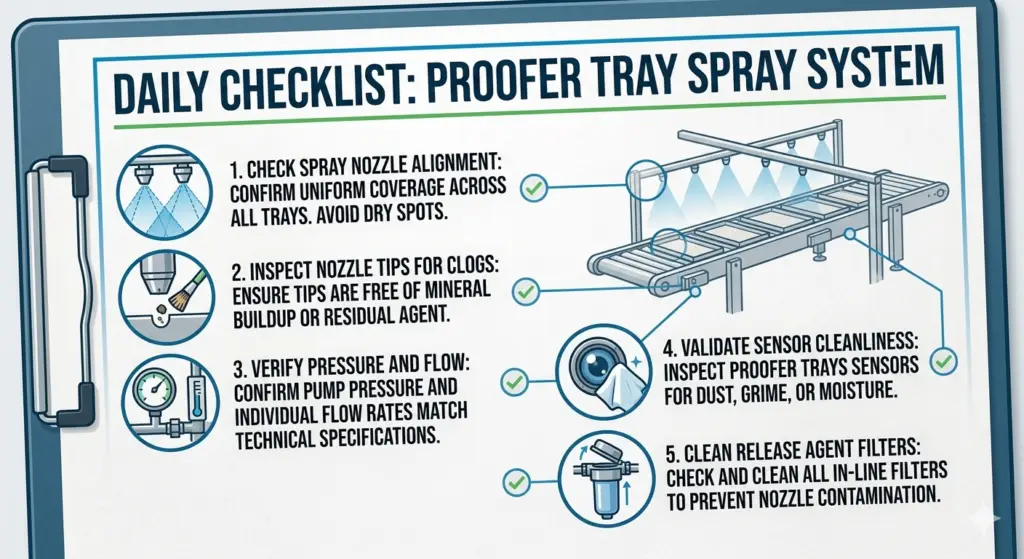
5-point daily check for spray nozzle alignment and sensor cleanliness.
Mistakes to Avoid on the Floor
🔹 Common Mistakes
- Over-dusting: Adding too much flour can backfire. If the flour becomes wet, it forms a thick paste that is harder to remove than the dough itself.
- Neglecting Tray Washers: If your tray washer isn’t reaching 60°C, it won’t effectively strip old, oxidized oils.
- Ignoring Airflow: Stagnant air pockets in the proofer corners lead to localized high humidity and sticking in specific zones.
For most industrial hamburger bun lines, the ideal relative humidity (RH) ranges between 80% and 85%. This level provides enough moisture to keep the dough skin flexible for expansion without causing surface wetness. Specifically, you should maintain a dry-bulb temperature of approximately 38°C to 42°C, with a wet-bulb temperature that prevents the dough from “sweating” or forming a crust.
To remove stubborn carbonized buildup, you must use an ultrasonic cleaning tank filled with a high-alkaline, food-safe degreaser. Standard pressure washing often fails to reach into the mesh crevices. If your plant lacks ultrasonic equipment, a soak in a 60°C to 70°C caustic solution followed by a stiff-bristle mechanical scrub will strip oxidized oils. Always ensure you re-coat the trays with a fresh release agent or silicone after cleaning to prevent immediate flash-rusting or sticking.
Dusting flour turns into a paste when the proofer’s humidity exceeds the flour’s moisture absorption limit, typically above 85% RH. When excess steam condenses on the tray, it hydrates the dry flour particles into a slurry. Furthermore, if your trays are colder than the proofer environment, the resulting dew-point condensation will immediately turn the dusting layer into an adhesive rather than a release barrier. Keep your trays warm and your humidity strictly controlled to avoid this.