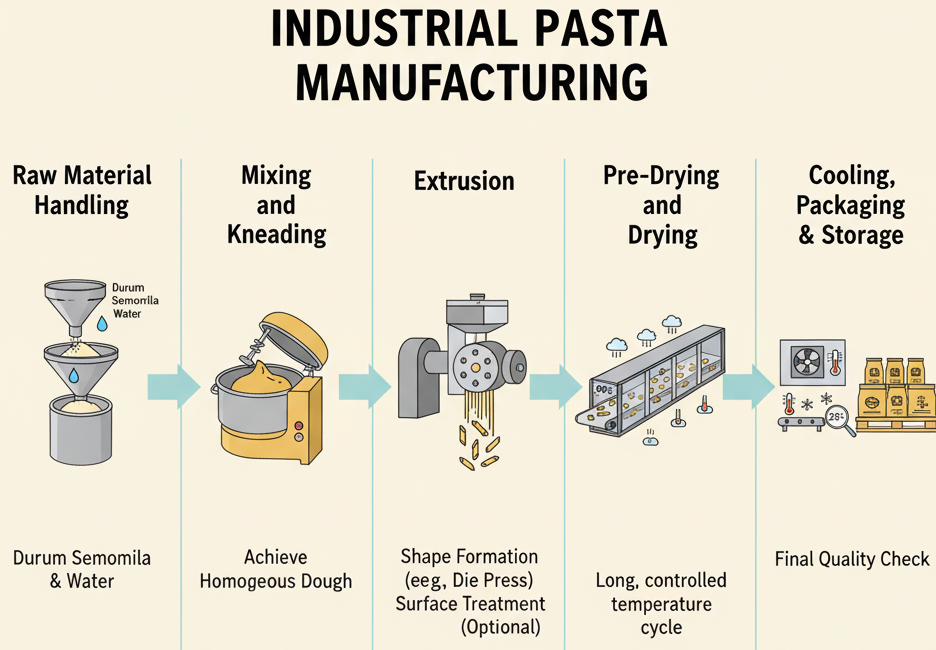
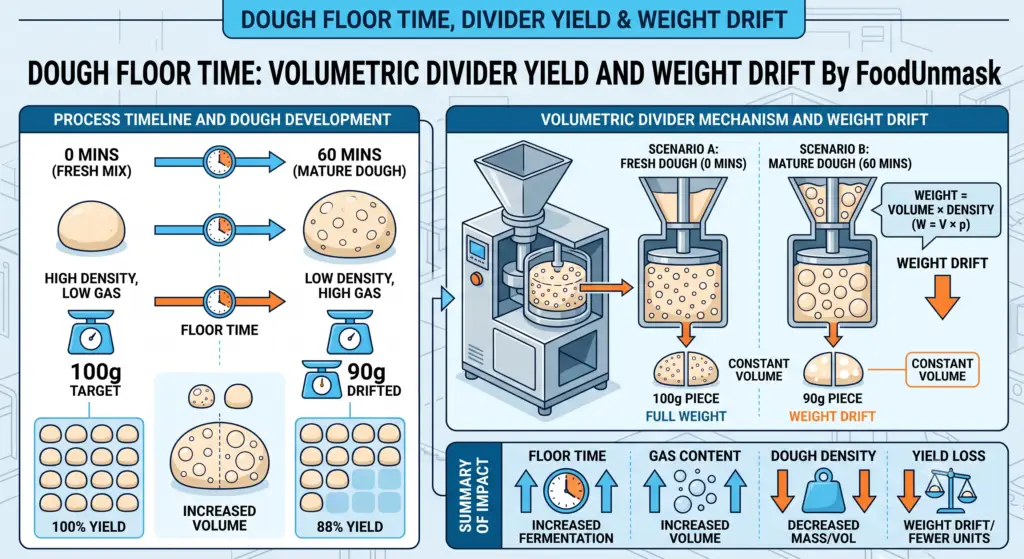
Dough floor time directly impacts volumetric divider yield through rapid shifts in specific density. As dough ferments on the processing floor, yeast activity generates CO₂ gas cells, expanding the matrix and lowering the overall density. Consequently, fixed-volume divider pockets fill with empty gas pockets instead of solid dough mass, causing a steady piece-weight drop over time.
🔹 Key Takeaways
- Density Decay Rate: Uncontrolled floor time causes dough specific density to drop from an initial 1.15 g/cm³ down to less than 0.95 g/cm³ within 45 minutes.
- Target Variance: To maintain high-speed line efficiency, operations must target a dough density variance of under ±1% across the entire batch run.
- Yield Loss: A 45-minute unmanaged floor time window can result in a piece-weight drop of up to 4% to 6%, causing structural scaling errors downstream.
🔹 Introduction
In high-speed, automated commercial baking lines, precision is everything. An extra 15 minutes of unmanaged dough floor time can quietly devastate your scaling accuracy before the product even hits the proofer.
This phenomenon—where piece weights steadily drop over the course of a single batch run—is driven by fundamental rheological changes.
To eliminate this operational headache and secure an immediate micro-win today, implement a strict “First-In, First-Divided” (FIFD) hopper staging protocol to keep your batch processing window under a strict 30-minute threshold.
Why Dough Age Causes Piece-Weight Drift
Volumetric dividers operate on a simple mechanical premise: they assume that a fixed volume equals a fixed weight. However, dough is a dynamic, living biochemical matrix.
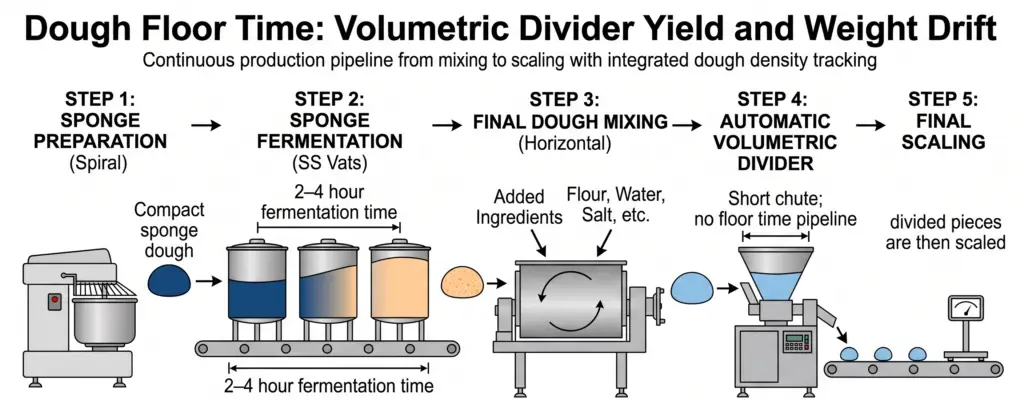
From the moment the mixer unloads, the yeast population is actively fermenting, converting simple sugars into carbon dioxide (CO₂) gas and ethanol.
This internal gas generation alters the dough’s specific volume. Because a volumetric divider cannot distinguish between the weight of a solid gluten-starch matrix and the weight of an empty gas pocket, it continues to cut the exact same physical volume. Consequently, as the batch ages on the floor, the actual mass packed into each stroke decreases, leading to a severe downward drift in scaling weights. Sometimes we face dough tearing during spiral mixing; for this, you can read our article Dough Tearing in Spiral Mixers: Technical Causes and Fixes.
Systematic Steps to Fix Divider Weight Drift
1. Establish a Dough Temperature Control Standard (DTCS)
Yeast metabolic activity is highly temperature-dependent. Therefore, you must control your water chilling systems to ensure a consistent out-of-mixer dough temperature of 26°C ± 0.5°C. Every 1°C increase above this target accelerates gas production by approximately 10%, which drastically compresses your usable floor time window.
2. Implement “Zone-Based” Batch Sizing
Match your mixer batch sizes precisely to the pull-rate of your automated makeup line. For example, if your divider processes 2,000 kg of dough per hour, a 1,000 kg batch will take 30 minutes to clear the hopper. Furthermore, you should never size a batch to exceed a 35-minute run window from the time of discharge.
3. Calibrate Divider Pressure and Degassing Mechanisms
Adjust the mechanical compression or vacuum settings on your volumetric divider (such as AMF or Baker Perkins lines) to gently degas the dough as it enters the pocket. Specifically, increasing the pocket suction or main ram pressure forces large gas bubbles to collapse, thereby restoring a more uniform density before the cut.
4. Automate Dynamic Pocket-Volume Compensation
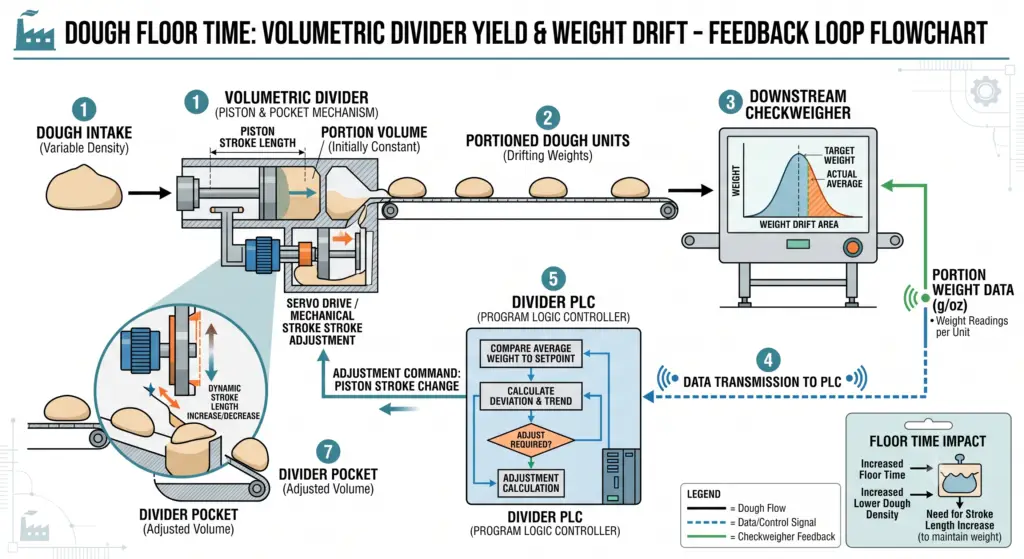
Integrate an inline checkweigher immediately downstream from the divider belt. Link the checkweigher’s data feed via a feedback loop directly to the divider’s PLC. Program the PLC to automatically enlarge the mechanical volume of the divider pocket by a fractional percentage for every 0.5% drop in average piece weight detected over a rolling 60-second window.
What the Manual Doesn’t Tell You (The Technical Edge)
Standard equipment operating manuals assume a perfectly homogeneous dough matrix. On the factory floor, however, the real culprit behind erratic scaling is micro-climate stratification and rheological shear thinning.
When a large 1,000 kg chunk of dough sits in a trough, the core of the mass retains heat due to exothermic fermentation, while the outer surface cools down due to ambient factory air currents. This disparity creates an uneven microclimate. The warmer core ferments faster, exhibiting a much lower density than the cooler skin.
Furthermore, as the divider’s ram compresses the dough, it applies sharp mechanical shear stress. Older dough that has developed a strong, gas-inflated gluten network undergoes rheological work softening under this stress. The gas cells coalesce unevenly, causing sudden, erratic weight drops in the middle of a batch run that standard static calibration completely misses.
Technical Specifications & Industry Benchmarks
According to standard industrial food engineering principles, dough density follows an inverse exponential decay model relative to fermentation time:
p(t) = p₀ × e^(-kt)
Where:
- p(t) is the calculated dough density at time t
- p₀ is the initial dough density at discharge (approximately 1.15 g/cm³)
- k is the specific fermentation velocity constant determined by matrix temperature and yeast concentration
To comply with global food quality control benchmarks (such as AIB International standards), commercial high-speed operations must maintain a target weight tolerance of ±1.5% of the total target bun or loaf weight. To achieve this downstream, the raw dough specific density variance must be rigidly constrained to under ±1% during its staging phase.
Diagnostic Reference Table
| Symptom | Probable Cause | Technical Fix |
| Progressive weight drop from start to end of batch | Yeast over-activation due to extended floor time or high discharge temperature. | Reduce batch size to match a max 30-minute processing window; lower water temperature to hit 26°C. |
| Erratic, spiking weight variances within a 5-minute window | Inadequate degassing or uneven micro-climates in the dough trough. | Increase divider ram/vacuum pressure; implement automatic trough turning or cooling jacket controls. |
| Dough tearing or skinning at the divider pocket outlet | Poor dough elasticity caused by gluten degradation from extended organic acid buildup. | Shorten total floor time; introduce a texturizing enzyme or ascorbic acid oxidizing agent to the formula. |
Critical Mistakes to Avoid on the Floor
- Topping Off Hoppers: Never dump a fresh, dense batch of dough directly on top of an old, gaseous batch remaining in the divider hopper. This creates extreme density stratification, leading to wild, unpredictable weight swings.
- Ignoring Ambient Humidity: Allowing the top layer of dough in open troughs to dry out forms a hard “skin.” When fed into the divider, these pieces of skin do not compress evenly, fouling the volumetric sensors.
- Compensation via Manual Hand-Wheels: Relying on operators to manually adjust the divider pocket volume via mechanical hand-wheels introduces human error and lag time, usually resulting in over-compensation and massive product giveaway.
Stabilizing your volumetric divider yield requires balancing mechanical precision with biochemical timing. By locking down dough floor time, you protect your bottom line against invisible yield drain. Is product giveaway hurting your margins? [Contact our industrial baking consultancy team today]
People Also Ask
Higher yeast percentages increase the rate of CO₂ production, which accelerates the drop in dough density. If your formulation requires a high yeast load, your allowable floor time window must be shortened proportionally to prevent weight drift.
While conditioners like DATEM or enzymes improve gas retention and dough elasticity, they do not stop fermentation. They can make the dough density more uniform, but structural floor-time management is still required.
The ideal setting depends on the dough’s hydration and density, but generally, a consistent vacuum pressure between 0.4 bar and 0.6 bar is required to properly collapse excess gas pockets without tearing the gluten matrix.